
The chemistry
What is ASR?
Alkali-Silica Reaction (ASR) is a chemical process that destroys concrete from the inside out. It has been documented in civil engineering since the 1940s, affecting bridges, highways, and foundations worldwide. Austin became the most significant outbreak site for swimming pools in the United States.
When reactive silica in the concrete aggregate meets alkaline compounds in cement paste in the presence of water, a gel forms. That gel absorbs water, swells, and creates internal pressure the concrete shell cannot contain. Cracks appear. Water enters those cracks. The reaction accelerates.
A swimming pool is the worst possible environment for ASR-affected concrete. It sits in water 24 hours a day. Once the reaction begins, it cannot be reversed. Surface repairs, patching, and resurfacing do not stop what is happening inside the structure.
Step by step
How the reaction progresses
- 01Reactive aggregate enters the mixCrushed rock or sand containing reactive silica is used in shotcrete without testing.
Reactive aggregate enters the mix
Crushed rock or sand containing reactive silica is used in shotcrete without testing.
- 02Fly ash is absentThe protective additive that suppresses ASR was removed from mixes during the supply shortage. Builders were not notified.
Fly ash is absent
The protective additive that suppresses ASR was removed from mixes during the supply shortage. Builders were not notified.
- 03Gel forms inside the concreteThe chemical reaction produces an expansive gel within the concrete matrix.
Gel forms inside the concrete
The chemical reaction produces an expansive gel within the concrete matrix.
- 04Internal pressure buildsThe swelling gel creates stress the shell cannot hold. Hairline cracks become structural cracks.
Internal pressure builds
The swelling gel creates stress the shell cannot hold. Hairline cracks become structural cracks.
- 05Water accelerates everythingEvery rainfall, every pool top-off feeds the gel further. The pool environment guarantees the reaction continues.
Water accelerates everything
Every rainfall, every pool top-off feeds the gel further. The pool environment guarantees the reaction continues.
Once the reaction begins, it cannot be reversed.
Surface repairs, patching, and resurfacing do not stop what is happening
inside the structure.
Why here
Why did ASR become an epidemic in Central Texas?
ASR in pools is rare nationally.
Austin's outbreak was the result of several problems converging at the same time.
Why did fly ash disappear from Austin pool concrete?
Class F fly ash, the additive that reliably suppresses ASR, became difficult to source during 2019–2022 due to supply chain disruptions. Some concrete suppliers quietly removed it from their mixes without informing pool builders. Mix tickets confirming the concrete composition were rarely requested or provided, leaving builders unaware of the change.
How did the COVID-19 construction boom contribute?
The pandemic triggered an unprecedented surge in residential pool construction across Central Texas. Builders were overwhelmed with demand, construction timelines compressed, and quality oversight dropped. Thousands of pools were poured in a short window, many from the same suppliers providing compromised concrete mixes.
Is Central Texas geology part of the problem?
Yes. Most aggregate quarried in Central Texas contains some degree of reactive silica. It is a geological characteristic of the region. Without fly ash as a preventive measure, ASR was not simply a risk. In many cases it was a near certainty given the local rock composition.
Which Austin-area neighborhoods are most affected?
Affected pools have been identified throughout greater Austin including Lakeway, Bee Cave, Westlake Hills, Dripping Springs, Cedar Park, Round Rock, Georgetown, and Pflugerville. West Austin and Lakeway appear frequently due to the high concentration of custom pools built during the 2019–2022 period.
Why did it take years for homeowners to notice?
ASR typically does not produce visible surface damage until two to five years after construction. By the time homeowners observed cracking, hundreds of pools were already compromised. The delayed symptom timeline also meant that many builders had completed dozens of additional pools using the same concrete before the problem was identified.
What to look for
How to identify ASR in a swimming pool
ASR produces distinct visual patterns
that differ from normal concrete wear or settlement cracking. These are the signs to look
for. Visual signs alone do not confirm ASR. Only a laboratory core sample analysis can do
that.
Map cracking
Spider-web or “alligator skin” crack patterns spreading across the shell floor and walls. Not linear or isolated, but a networked pattern of interconnected cracks.
Gel at crack surfaces
A white or translucent gel-like substance visible at crack openings. This is ASR gel being pushed outward from inside the concrete matrix under internal pressure.
Unexplained water loss
Shell cracks allow pool water to escape into surrounding soil. Frequent need to top off the pool, beyond normal evaporation, warrants investigation.
Tile separating
Waterline tile pulling away or popping off the shell. The concrete expanding from internal pressure pushes tile loose from the bond coat.
Cracks at spa or ledge
Cracking concentrated at thinner concrete zones such as spa walls, steps, and tanning ledges, which experience the expansion stress first due to reduced mass.
Cracks that are spreading
Unlike settlement cracks which stabilize, ASR cracks actively grow over time. Cracking that has visibly worsened over months indicates the reaction is still progressing.
Visual observation alone cannot confirm ASR.
Cracking has multiple causes including settlement, shrinkage, and plaster
failure. A definitive diagnosis requires a petrographic examination: core samples extracted
and analyzed by a licensed engineer under a microscope. Do not proceed with demolition or
legal action based on visual signs alone.
Confirming it
How ASR is confirmed
Two testing methods are used to confirm
ASR in swimming pools. Understanding both matters, for accuracy, for insurance claims, and
for any legal proceedings.
01 Rapid gel testing
A surface sample is taken and chemically tested for the presence of ASR gel. Results return within 72 hours.
- Fast turnaround, useful for initial confirmation
- Lower cost than petrographic analysis
- May not be accepted for insurance claims or litigation
- Surface-only; does not assess structural extent
02 Petrographic examination
Core samples are drilled from the shell and examined under a microscope by a licensed engineer. The industry gold standard.
- Definitive ASR confirmation
- Documents structural extent and severity
- Required for most insurance claims and lawsuits
- Cost of $7,000 to $10,000, and a significant wait
Note on timing: Austin-area forensic labs have been experiencing a
two to three month backlog for ASR core sample analysis due to the volume of affected
pools. If legal action is a possibility, begin testing early. Delays can affect your claim
timeline.
If removal is the answer
What ASR pool demolition involves
ASR pool removal is more involved than
standard pool demolition. The nature of the compromised material, permit requirements,
documentation needs, and site preparation all require a structured approach. Here is what a
thorough process looks like.
- Permitting and planningAustin requires a permit for pool removal. A reputable contractor pulls permits before work begins and coordinates utility marking, including gas, water, electric, and communications, across the site. Access routes for equipment are confirmed. For ASR documentation purposes, site photos are taken before any work starts.
Permitting and planning
Austin requires a permit for pool removal. A reputable contractor pulls permits before work begins and coordinates utility marking, including gas, water, electric, and communications, across the site. Access routes for equipment are confirmed. For ASR documentation purposes, site photos are taken before any work starts.
- Equipment disconnectionPumps, filters, heaters, lighting, and automation systems are disconnected by licensed electricians and plumbers. Plumbing is properly capped. These steps are prerequisites. Skipping them creates liability and fails city inspection.
Equipment disconnection
Pumps, filters, heaters, lighting, and automation systems are disconnected by licensed electricians and plumbers. Plumbing is properly capped. These steps are prerequisites. Skipping them creates liability and fails city inspection.
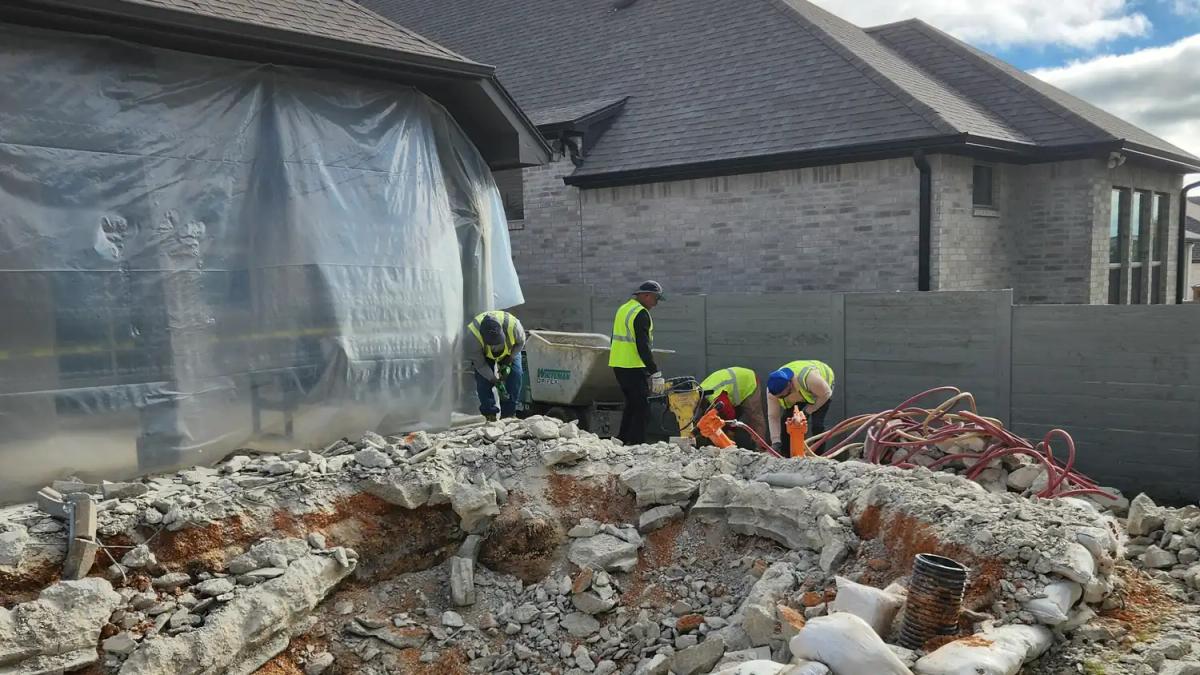
- Full concrete removalFor ASR pools, full removal is almost always the correct approach. Partial demolition, leaving the bottom shell and punching drainage holes, leaves compromised and still-expanding concrete underground. It causes long-term soil instability and limits future use of the site. Full removal means all concrete, rebar, plumbing, tile, and coping come out.
Full concrete removal
For ASR pools, full removal is almost always the correct approach. Partial demolition, leaving the bottom shell and punching drainage holes, leaves compromised and still-expanding concrete underground. It causes long-term soil instability and limits future use of the site. Full removal means all concrete, rebar, plumbing, tile, and coping come out.
- Debris haul-offA demolished pool produces substantial volume: concrete rubble, tile, rebar, plumbing, and coping material. All debris leaves the property. Confirm haul-off is included in any quote you receive, not billed separately by load.
Debris haul-off
A demolished pool produces substantial volume: concrete rubble, tile, rebar, plumbing, and coping material. All debris leaves the property. Confirm haul-off is included in any quote you receive, not billed separately by load.
- Layered backfill and compactionThe cavity is filled in layers, typically clean fill soil and gravel, with mechanical compaction at each layer. This is the most commonly skipped or rushed step. Without proper compaction, the site will settle, creating low spots and unstable ground. Layer thickness and compaction method should be specified in any scope of work you receive.
Layered backfill and compaction
The cavity is filled in layers, typically clean fill soil and gravel, with mechanical compaction at each layer. This is the most commonly skipped or rushed step. Without proper compaction, the site will settle, creating low spots and unstable ground. Layer thickness and compaction method should be specified in any scope of work you receive.
- Final grade and cleanupThe site is graded to drain away from the structure and match surrounding yard elevation. A proper finish grade prevents ponding and erosion. The city final inspection closes out the permit.
Final grade and cleanup
The site is graded to drain away from the structure and match surrounding yard elevation. A proper finish grade prevents ponding and erosion. The city final inspection closes out the permit.
Where Rebold fits
If removal becomes the right next step
Rebold handles the demolition and removal side of an ASR pool project. We do not
diagnose the concrete condition and we are not the party confirming ASR. That work
belongs with a licensed engineer and a lab.
Once you know what you are dealing with and removal is the direction, we can plan the
work around your property, pull the permits that apply, and leave the site prepared for
whatever comes after.
Common questions
Answers before you call
Can an ASR pool be repaired instead of demolished?
No permanent repair exists for ASR. Surface patching, resurfacing, and epoxy injection temporarily conceal cracks but do not stop the chemical reaction inside the concrete. As long as moisture is present, which is always the case in a pool, ASR continues to progress.
How much does ASR pool demolition cost in Austin?
Pool demolition in Austin typically ranges from $15,000 to $25,000 depending on pool size, equipment access, fill requirements, and whether engineered backfill is included. Engineered backfill adds cost but provides legal and resale documentation.
How long does ASR pool demolition take?
Most residential ASR pool demolitions take five to ten working days from start to finish, including permit, demolition, haul-off, backfill, compaction, and final grade. Timeline varies based on pool size, site access, and permit processing time.
Does homeowner's insurance cover ASR pool damage?
Coverage varies significantly by policy. Many insurers treat ASR as a construction defect rather than a covered peril, which can complicate claims. Documentation from petrographic testing and a written demolition scope are typically required. Consult your insurer and an attorney before proceeding.
Which Austin pool builders have been sued for ASR?
Hundreds of lawsuits have been filed in Central Texas against pool builders and concrete suppliers. Several Austin-area pool construction companies have filed for bankruptcy as a result of ASR-related litigation. The legal landscape is active and ongoing. An attorney specializing in Texas construction defect cases can advise on current proceedings.
What can I build on the site after pool removal?
With a full removal and engineered backfill, the site can support lawn, landscaping, a patio, hardscape, or a new pool rebuild. Partial removal limits future use. The site is generally not buildable and must be disclosed to buyers. Engineered backfill certification documents what the land can support.